

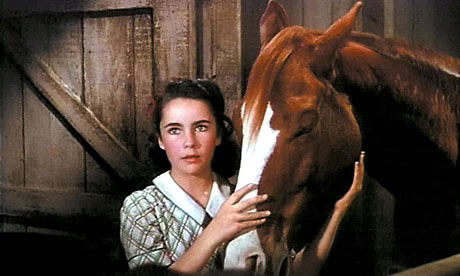
A close cultural association between the horse and women encounters an interesting fork in the road with the appearance of Lump Sugar (2006) and Champ (2012). Both films follow young female jockeys and their affective attachment to horses, foregrounding a bond structured as partnership and mutual understanding—forms of relationality traditionally reserved for human subjects. This anthropomorphic affinity is not entirely new. National Velvet (1944), for instance, famously captures this intimacy when the twelve-year-old Velvet describes her horse as having “burst her heart out,” running for her to win the Grand National, a race she enters disguised as a male jockey. Here, the horse appears as something more than a repository of mythic or symbolic meaning; it emerges as a responsive, almost spiritual partner.
This addition of a “spiritual” or affective horse raises a series of questions: why is this expanded notion of animal interiority so often mediated through female protagonists, and does its cinematic resurgence bear any relation to the broader emergence of environmental consciousness?
Horse-racing films place the animal at a peculiar intersection between cultural imagination and material reality. Historically, the horse has been associated with vitality, wisdom, and loyalty, and in some traditions even functions as an intermediary between the earthly and the celestial. The cinematic articulation of the horse as a conduit of sexual desire—as in Madam Aema (1982)—may appear excessive or anomalous, yet it remains consistent with longer symbolic histories in which the animal figures primarily as concentrated energy and power, stripped down to its libidinal force.
Racing films retain this association with vitality while thrusting the horse into one of the most unforgiving competitive systems, structured by the logic of winner-takes-all. In this genre, racing often functions as a cinematic shorthand for a society driven by ruthless competition, where monetary gain eclipses fairness and ethical consideration. The horse thus circulates within a field of meanings that is unmistakably modern and human, even as it continues to carry older, premodern symbolic resonances. The result is a tension between natural vitality and the man-made system that seeks to instrumentalize it.
Within this framework, victory is frequently read as a moment in which the spiritual force embodied by the horse triumphs over a system indifferent to humanity, ethics, or natural order. Yet such an interpretation risks overlooking the more troubling complexity of the horse’s position within the system itself—particularly the expectations imposed upon animal life. The horse’s presumed intelligence, emotional sensitivity, communicative capacity, and loyalty are often treated as natural attributes, but these qualities are in fact culturally contingent, historically variable, and narratively assigned. It is through this shifting set of expectations that the role and meaning of the animal are continually produced and revised.
Lump Sugar
Si-eun, who grows up without her mother, dreams of becoming a jockey—a desire vehemently opposed by her father. On his farm lives an old mare named General, who provides the young Si-eun with warmth and emotional comfort. General dies while giving birth to a colt. Si-eun names the foal Chun-doong (Thunderbolt) and calls him her brother. The bond among Si-eun, General, and Chun-doong exceeds the familiar cinematic trope of human–animal affinity and instead assumes the structure of kinship. Given the privileged status of family in Korean cinema, this framing binds Si-eun and Chun-doong through a logic of fate in which life and death, endurance and loss, are shared rather than merely observed. This configuration elevates their relationship well beyond ordinary representations of human–animal interaction.
Their separation occurs when Si-eun’s father sells Chun-doong. Years later, Si-eun—now a jockey—encounters him again, paraded through the streets to attract customers to a cabaret, a reunion staged as if guided by fate. After buying him back, Si-eun and Chun-doong race together, eventually qualifying for the Grand Prix. Throughout this process, Chun-doong is repeatedly portrayed as understanding Si-eun’s aspiration to win. When a veterinarian later warns that Chun-doong’s lungs are critically compromised, the narrative invites an almost unavoidable interpretation: the horse has exceeded his physical limits in order to fulfill Si-eun’s dream. His death thus reads as sacrifice. Notably, a role traditionally assigned to maternal figures in Korean family melodrama—the self-effacing bearer of another’s future—is here transferred onto the horse.
Chun-doong, then, cannot be reduced to a symbol of natural vitality or resilience. He is fully incorporated into a human institution—family—and made to struggle on Si-eun’s behalf within the male-dominated, competitive world of horse racing, a space structured by prejudice and inequality. There is no simple triumph of nature or spiritual force in this narrative. At best, the “nature” embodied by Chun-doong is rendered indistinguishable from the human, absorbed into kinship and obligation. This subtle reconfiguration of nature is mediated through a female subject whose struggle unfolds within a ruthless system of competition. If victory is momentarily achieved, it is not because nature resists the system from outside, but because nature—humanized through familial attachment and female ambition—momentarily survives within it. What emerges is not environmentalism in any conventional sense, but a displaced ethics in which the promise of interspecies harmony is secured only through sacrifice.

The Coachman
What, then, constitutes the “natural” progression when the horse is fully integrated into the human system? One possible reading frames this integration as an advanced form of environmental consciousness, in which nature becomes indistinguishable from the human and thus escapes hierarchical valuation. An opposing critique, however, would note that such incorporation risks stripping nature of its material specificity, reducing it to a subspecies within the human order. Under this logic, nature’s value lies increasingly in its usefulness, and instrumentalization becomes more difficult to recognize precisely because it is reframed as care, cooperation, or familial obligation. Abuse, in this sense, need not appear as violence; it can be dignified as sacrifice.
Within this scheme, the only potential ethical gain lies in the demand for restraint—that an expanded sensitivity toward nature might prevent it from being pushed beyond its physical limits. Yet even this possibility remains unstable in Lump Sugar. Chun-doong is glorified for running on behalf of Si-eun’s ambition, despite the absence of any certainty that the horse shares her psychological desire for victory. The film’s emphasis on interconnection thus risks reproducing a familiar pattern: human aspiration projected onto the animal body and retrospectively naturalized as mutual understanding.
Korean cinema offers earlier precedents for this incorporation of the horse into human systems. In The Coachman (1961), the horse functions as a working animal whose labor sustains a widowed coachman and his four children. Embedded within the family economy, the horse becomes inseparable from survival itself, mirroring the conditions of postwar urban poverty and displacement. Here, the animal simultaneously signifies deprivation and endurance, its body absorbing the pressures of a society struggling to rebuild. While the symbolic register differs from that of Lump Sugar, the structural position remains comparable: the horse is rendered meaningful through labor and persistence rather than autonomy.
Lump Sugar extends this trajectory rather than departing from it. The horse no longer signifies vitality or survival but ambition, care, and aspiration. Yet this shift does not resolve the ethical tension at stake; it merely renders it less visible. The promise of coexistence remains deferred, appearing as an affective ideal rather than a material condition. What the film ultimately offers is not a vision of human–nature fusion, but a narrative in which integration functions as justification—allowing extraction to proceed under the language of intimacy.
