
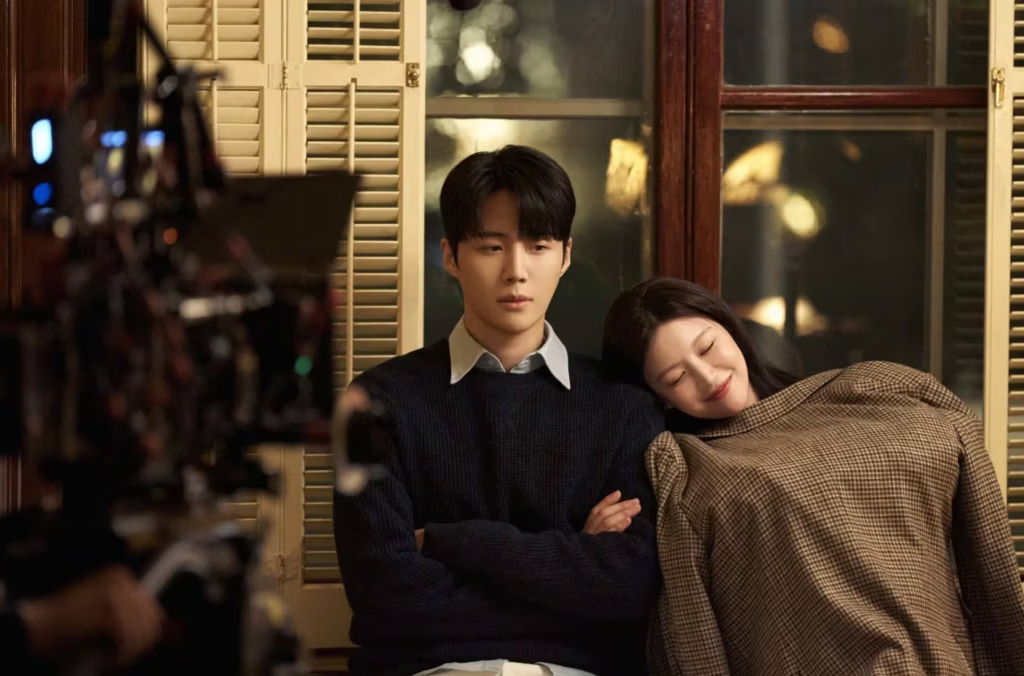
Korean romantic comedy dramas have their own enemies: dramatic clichés, also known as K-drama rules, that operate to make rom-coms predictable while simultaneously rendering them recognizable products, expected to deliver a certain kind of satisfaction. The male lead grabbing the female lead’s wrist and running, the tension between a poor girl and a rich man blossoming into love, the sharing of an umbrella—or a kiss beneath it—are hallmarks of the genre. These moments are not only repeated but expected to be repeated, their familiarity producing sweetness through anticipation rather than surprise. Even criticisms that Korean romantic dramas are far removed from reality lose much of their force in the face of these clearly defined genre rules, which reliably attract views, clicks, and binge-watching. Yet this does not mean that Korean romantic dramas constitute a fixed or stable set of conventions resistant to change. As a new series, Can This Love Be Translated? demonstrates that even the rules governing sweetness evolve with the times.
If romantic comedies are a distributary, melodramas are the main river of Korean television, a narrative form that is historically and culturally deep-rooted. Melodrama was among the most beloved genres during the golden age of Korean cinema in the 1960s. Reflecting postwar society, melodramatic films functioned as devices through which a wide range of issues—family structures, courtship, romantic longing, and the lives of war widows—were examined. By the 1970s, melodrama, as a powerful medium for depicting the interior lives of families and intimate relationships, had largely migrated to television. In any comprehensive account of TV melodrama in the 1970s and 1980s, one figure is indispensable: Kim Soo-hyun.
As the writer of numerous popular TV series, she created female characters who were persecuted yet resistant, confronting male-centered systems while still inheriting the archetypal qualities of 1960s cinematic heroines—women who sacrificed themselves for their families despite their acute sense of injustice within domestic and romantic relations, often ending their narratives as wives or mothers assigned predetermined roles. Kim Soo-hyun’s heroines, however, differed in their willingness to articulate the imperfection of their lives, conditions that were not, in truth, a significant improvement on those of the past.
By the 1990s, the heyday of TV melodrama began to be eclipsed by romantic dramas. This shift, however, should not be understood as a clean break. Korean TV romantic dramas were born from the ashes of melodrama rather than in opposition to it. Although Hollywood’s romantic comedy tradition arguably dates back to It Happened One Night (1934)—in which a rich woman meets a poor newspaper reporter and finds love across class lines—Korean romantic dramas, as melodramatic descendants, retain a strong investment in family and its emotional splinters: guilt, duty, remorse, and obligation circulating among family members.
One defining feature of early Korean romantic dramas is the villainous mother who fiercely opposes her son’s relationship with a woman from a lower social class. This figure is a direct remnant of traditional TV melodrama, where the stubborn mother-in-law serves as the custodian of entrenched social values. On this shifting terrain, Korean TV romantic dramas emerged that remained within melodrama’s emotional territory while seeking new modes of approach—an evolution at which writers such as the Hong Sisters, the writers of Can This Love Be Translated? notably excelled.

Romantic Comedy in the Age of Social Media
The main character of Can This Love Be Translated?, Cha Mu-hee, is a struggling actress whose fortune changes abruptly when a zombie film in which she plays a living dead becomes a global hit. Her character’s name, Do Ra-mi, quickly turns into a widely used alias, with fans chanting “Do Ra-mi” instead of Cha Mu-hee wherever she appears. The only cost of this sudden reversal of fortune is the accident that occurs during the filming of the final scene, leaving her in a six-month coma. During this time, she remains entirely unaware of the film’s success. When she awakens, Do Ra-mi appears before her. Whether hallucination, intrusive memory, or the lingering afterimage of a character who now occupies every corner of the city—from bus shelters to gigantic billboards—this delusional presence destabilizes Cha Mu-hee’s psychological security. Do Ra-mi becomes an unnervingly attentive critic of her feelings, plans, hopes, and dreams, gradually turning Cha Mu-hee into a bundle of worries, doubts, anxieties, and guilt.
Among the spectrum of characters surrounding Cha, this unwanted critical voice most closely resembles the mother figures of classical TV melodramas, particularly those written by Kim Soo-hyun. Acting either on behalf of—or in the absence of—the father, such maternal figures represent family and its moral order. Through emotional manipulation, they bind daughters to the family system, converting desires for individual happiness into guilt and loyalty into obligation. Under this typified maternal authority, the daughter becomes a working mule, trapped beneath the burden of familial responsibility. As the female lead of a romantic drama, Cha Mu-hee predictably has a love interest, a rival who threatens her happiness, and friends who provide support. Yet within her universe of love and relationships, the most treacherous obstacle to self-fulfillment is neither a rival nor circumstance, but this internalized, motherly voice. In this sense, Can This Love Be Translated? does not stray far from the melodramatic tree from which romantic dramas grow.
At the same time, Can This Love Be Translated? offers a distinctly contemporary adaptation of the romantic drama, shaped by an era of self-display and self-promotion through social media. The series unfolds across photogenic tourist sites in Korea, Japan, Canada, and Italy—locations likely photographed millions of times by influencers and casual users alike. As a result, the drama feels like a romance reassembled through the visual grammar of social media aesthetics.
Another evolving feature of the series is its more pronounced reversal of gender roles. While not entirely new, this inversion is foregrounded with unusual clarity. In the first episode, Cha travels to Japan to confront her cheating boyfriend, only to realize that his attraction may have stemmed from her vulnerability and need for care. This moment of self-recognition is rendered through introspective comedy, signaling that the familiar trajectory—sympathy turning into love—will not serve as the narrative backbone of this romance. Instead, Cha develops feelings for her interpreter, Joo Ho-jin, who is the one in need of care. Nearly flawless on the surface—multilingual, logical, emotionally composed, and meticulous—Joo remains unable to follow his heart, locked away by wounds from the past. In this series, it is Joo who must be rescued, not Cha Mu-hee. The figure of the damsel in distress is thus quietly but decisively displaced.

Romance after Fantasy
The Hong Sisters previously experimented with gender-role reversal through a touch of horror in The Master’s Sun (2013). The male lead, Joo Joong-won, is a charismatic shopping mall owner with a secret known only to a small inner circle. Traumatized by a childhood kidnapping, he is dyslexic and relies on someone else to read through the piles of documents necessary for his business decisions. Afraid that this vulnerability might undermine his authority—particularly among board members—he turns to his personal secretary, the female lead, Gong-shil. Beneath his confident and aggressively masculine façade, Joong-won is deeply flawed and dependent on care. He is a man-child unwilling to admit his frailty, yet his character quietly proves that strength in romantic relationships does not naturally belong to men, nor does the need for care belong exclusively to women. The drama romanticizes a love that grows out of understanding and commitment, though whether this dynamic genuinely empowers women or merely reinscribes them as natural caregivers remains an open question.
In The Master’s Sun, Gong-shil can see ghosts—an ability she fears, as spirits aware of her gift constantly demand favors. Strikingly, these ghosts disappear whenever she touches Joong-won, binding the two in mutual necessity. Can This Love Be Translated? echoes this structure in a softer, less fantastical register. Ho-jin continues the lineage of male characters in need of care and guidance, while Mu-hee is haunted not by ghosts but by an apparition-like version of herself—an internal presence that erodes her sense of wholeness and recalls the domineering maternal figures of classical TV melodrama. Their romance, too, is built on care and commitment, but it unfolds within the visual economy of the social media age: a sequence of carefully photographed encounters, tender moments, forlorn farewells, and gradually accumulating feelings. In this sense, Can This Love Be Translated? becomes a confluence of generations of Korean romantic drama, where melodramatic inheritance meets digital aesthetics. It is a romance imagined after fantasy—less concerned with sweeping declarations than with the fragile work of staying emotionally available.