

Long before BTS topped the global charts with “Arirang,” a silent film bearing the same name shook the foundations of Korean culture—and then vanished from the face of the earth. This year marks the centenary of the film, rendering its disappearance all the more poignant.
In 1926, Korea was under Japanese colonial rule, and its film industry remained sluggish in catching up with the major cinematic power hubs. Hollywood, by contrast, released films such as The Black Pirate, The General, The Scarlet Letter, and Don Juan. The latter, in particular, signaled a transition toward the sound era through its use of the Vitaphone sound-on-disc system. Although it contained no spoken dialogue, it featured synchronized music and sound effects. By this point, the two axes that would define Hollywood as a prolific industrial center—stars and genre—were already firmly in place.
It is often said that around 90% of films screened in Korea in 1926 were imports from Hollywood. Domestic production lagged behind: the first Korean film, Fight for Justice, appeared in 1919, followed by the public information film The Vow Made Below the Moon in 1923. Then Arirang arrived, reshaping the perception of Korean cinema.
The film possessed many of the elements of an action narrative: a recognizable hero, a villain, and a clear moral arc structured around the struggle between good and evil. More crucially, however, it spoke directly to the lived reality of Koreans under Japanese rule. In the film’s final sequence, the protagonist Yeong-jin is taken away by the Japanese police, accompanied by the song “Arirang.” According to popular accounts, audiences wept—and sang along.
The film’s disappearance remains a mystery. It may have been destroyed during the Korean War, or simply neglected and left to decay in a private archive. Film historians and preservationists have long searched for it, while others have attempted partial reconstructions.
Today, millions of listeners around the world stream BTS’s explosive new releases. Yet long before the title belonged to K-pop royalty, it belonged to a 1926 silent film—a cinematic act of defiance that gave voice to an occupied people. As global audiences celebrate the contemporary triumph of Korean culture, this may be the moment to search again for this lost work.
This essay proceeds as a kind of search warrant for one of cinema’s holy grails—an object erased from material existence, leaving only traces and afterimages. Whether one approaches as a fan of Korean culture or as a professional in film history, certain clues demand attention. The following are signals that might guide such a search.
1. The Swashbuckling Face of Director and Actor, Na Woon-gyu
Na Woon-gyu was the screenwriter, director, and actor of Arirang—quite literally, it was his creative child. His achievement lay in how he absorbed elements of Western filmmaking and wove them into a distinctly Korean mode of storytelling. In the 1920s, Korean cinemas were filled with imported Hollywood genre films, including swashbucklers, and stars like Douglas Fairbanks were familiar to local audiences. Na’s ambition was to create something just as compelling—equally exciting, equally cinematic. In doing so, he expanded the horizons of Korean cinema, which had largely been confined to adapting stories from other media. Through Arirang, Korean cinema began to find its own voice.
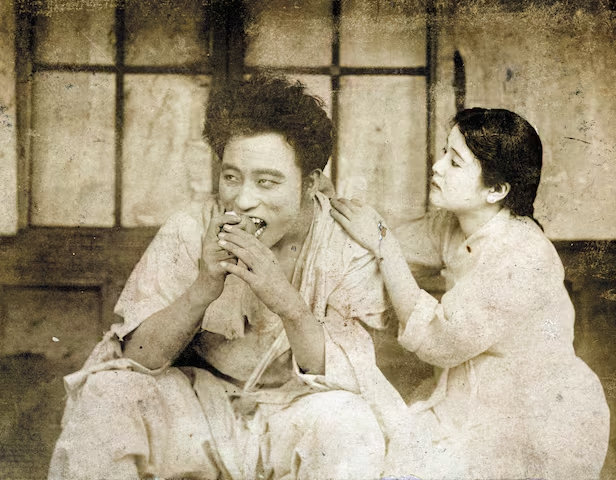
Following the film’s success, Na quickly rose to stardom. He was not conventionally handsome, yet his face carried an extraordinary dramatic expressiveness. In Arirang, he plays Young-jin—a character who is at once an elite student, a madman, a murderer, and a quiet yet potent symbol of resistance under colonial rule. Intelligent, volatile, introspective, and defiant, Young-jin is a figure of contradictions—and Na embodies them all. A contemporary critic compared him to Lon Chaney, while noting he was no Douglas Fairbanks. Harsh as that may sound, it reveals just how unforgettable his presence was.
Look closely: the dark eyebrows, the intense eyes, the hollow smile. If you catch that face, that might be Na. And just like that, you may have found Arirang.
2. The Song of Arirang
Na Woon-gyu once recalled in an interview that he had listened, in his hometown, to laborers singing “Arirang.” The song left a deep impression on the young Na—so much so that he later incorporated it into his film.
“Arirang” was already a widely known Korean folk song, with numerous regional variations. Despite its simple melody and repetitive refrain, it carries a distinctive poetic resonance. Yet it remained one among many folk songs until the film Arirang, in which it accompanies the departure of the protagonist Yeong-jin, taken into Japanese police custody after killing a stooge of the colonial regime. As the character leaves the rolling hills of his home, the song acquires a new affective weight.
From that moment, “Arirang” became irrevocably attached to a complex emotional register: deep sorrow, unfulfilled longing, resilience, and quiet grievance—affects closely associated with life under colonial rule. In this sense, the song came to function as a kind of Korean “Danny Boy,” carrying both national sentiment and diasporic melancholy.
Precisely because the song “Arirang” is far more widely known than the film, it may serve as a crucial keyword in the search for the lost work. Archive index cards, library catalogues, or database entries containing the term “Arirang” might yield unexpected traces. Materials related to the film may have been catalogued simply under the song’s title and thus misidentified. What appears to be a record of the song could, in fact, be a fragment of the film.
The coincidence of title—Arirang as both song and film—creates a layer of archival confusion. Yet within that confusion lies a potential clue, even an Easter egg for the attentive researcher.
The title resurfaces again in the contemporary moment. BTS have also invoked “Arirang” in their recent work, prompting various interpretations. One reading suggests that it signifies a seed of change and renewal, pointing to growth and new life. While such interpretations may risk overreading, they nonetheless gesture toward Arirang as a cultural turning point.
If the 1926 film Arirang marked a moment when Korean cinema, building on Western cinematic forms, discovered its own creative ground, then BTS’s invocation of the same title may signal a different kind of global articulation. The group is undoubtedly aware of the song’s deep sentimental value. Their gesture may not seek to erase the past, but rather to reactivate the affective power of “Arirang” as a form capable of transmitting something essential about Korean identity across cultures.

3. Where to Look
The history of Arirang (1926) is shrouded in decades-long rumors, secret inventories, and archival dead ends. Because the original print vanished during the chaos of the Korean War, the search for a surviving copy has generated narratives that increasingly resemble a political thriller rather than a conventional story of film preservation.
The most persistent lead centers on the Japanese collector Yoshishige Abe, the son of a colonial-era police officer, who claimed to possess a private vault of over 50,000 films—including, allegedly, a pristine print of Arirang. According to reports, Abe even presented a handwritten inventory list to journalists, offering tantalizing proof of the film’s existence within his collection. Yet upon his death in 2005, the archive was absorbed into the custody of the Japanese government, after which the trail effectively disappeared. What remains is a silence shaped as much by bureaucratic opacity as by unresolved historical tension.
Other theories extend the search beyond Japan. Because Na Woon-gyu was associated with anti-colonial resistance, some have speculated that a print of the film may have been smuggled across borders during the colonial period or in the years that followed. One persistent rumor places the film within the vast and largely inaccessible archives once associated with Kim Jong-il, whose well-documented obsession with cinema led to the accumulation of thousands of films. In this account, Arirang survives not as a public artifact, but as a sealed object within a state-controlled cinematic vault.
There are, of course, darker interpretations. Some suggest that the film did not simply disappear in wartime chaos, but was systematically destroyed by colonial authorities seeking to erase its nationalist message. In such a scenario, the absence of Arirang would not be accidental but deliberate—a form of cultural erasure inscribed into the very history of the archive.
Yet to follow only these grand conspiracies may be to overlook a more diffuse, and perhaps more plausible, possibility. Films travel. Prints circulate, are misplaced, exchanged, or quietly absorbed into collections far removed from their origin. A Korean independence activist might have carried a reel abroad, depositing it, knowingly or not, in a private collection in the United States. A mislabeled canister might sit, unexamined, in a regional archive—perhaps in a place like Vladivostok, where histories of migration, empire, and Cold War exchange intersect.
The search for Arirang is not confined to one nation, one archive, or one political system. It unfolds across a dispersed global network of collections, catalogues, and forgotten holdings. The film may reside in a state vault, a private basement, or a provincial archive whose inventory has not been revisited for decades. And precisely for that reason, the search must remain open—attentive not only to spectacular discoveries, but also to the quiet, easily overlooked traces that continue to circulate at the margins of film history.